#70 Local Street Management (pt 7) - Monitoring and Review
The seventh entry in the current series on Local Area Traffic Management (LATM), as informed by the AGTM Part 8: Local Street Management [1], outlines Stage 6 of the LATM process, covering Monitoring and Review. This stage follows Implementation as covered in Stage 5.
Value and objectives of monitoring and review
According to Austroads (2020, p.48), monitoring and evaluation of the final LATM scheme and intermediate stages is an essential step, yet is often overlooked or is insufficiently rigorous. Time and resource constraints are key factors that influence the adequacy of monitoring and evaluation, but this stage should be planned for in the early stages of an LATM project or program to manage such constraints. Austroads presents five key purposes of monitoring and evaluation, including:
Assessment of the overall scheme and individual treatments against the stated objectives (primary technical measure)
Identify negative impacts and potential solutions
Assess impacts at each stage to inform improvement in subsequent stages
Provide community with objective information on outcomes and effects
Performance evaluation for future reference and knowledge-sharing
It is critical that monitoring and evaluation is considered early and appropriate pre-implementation data collected to provide a baseline against which the effects of changes can be assessed.
Indicators and parameters
Surveys of different types are the instruments used to collect monitoring and evaluation data, and a complete assessment will include both objective and subjective measures. Objective measures are likely to include multiple traffic and crash data points, potentially with economic data to facilitate cost-benefit analyses. Subjective measures may focus on attitudinal/behavioural surveys and feedback from community and/or relevant groups and stakeholders (including complaints).
Austroads identifies key parameters in the monitoring program as (p.48):
speeds
crashes (reported and unreported)
traffic volumes, traffic composition and time-of-day variation
cordon origin and destination survey (especially if through traffic has previously been an issue)
delay at exits from the area
resident attitudes (obtained passively or actively through surveys)
affects on, and responses of specific road users such as cyclists, commuters driving to work, commercial drivers and bus operators.
Crash data
Focusing on crash data as a key parameter, it is important to note the relationship between sample size and statistical significance and reliability, which can be problematic at the level of local areas. It is noted that “local area crashes are usually thinly spread and random events” and “valid analysis of crash changes at individual device sites or streets is rarely possible” (p.49).
Austroads suggests some strategies to manage these challenges in data analysis and also presents a guide on what constitutes “significant” crash reductions relative to baseline numbers, as reproduced below (Figure 1). Essentially, the lower the number of crashes in baseline data, the greater the percentage reduction needs to be to achieve statistical significance.
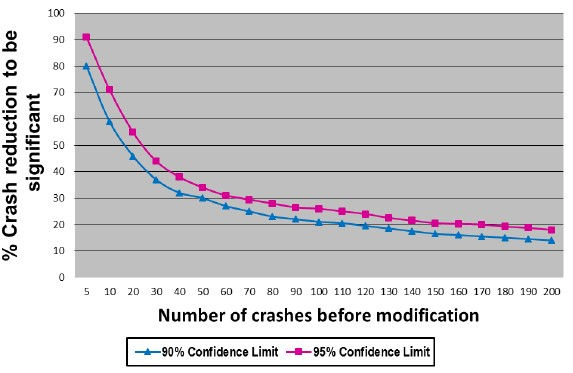
Figure 1: Crash change significance test chart (Austroads, 2020)
[1] Austroads (2020). Guide to Traffic Management Part 8: Local Street Management. Sydney, Austroads. https://austroads.gov.au/publications/traffic-management/agtm08